Power architecture
A complete power distribution plan showing all rails, sequencing requirements, and current budgets.
Efficient power conversion engineered for performance and reliability, from DC/DC converters and LED drivers to low-noise supplies and higher-power stages with proper thermal management.
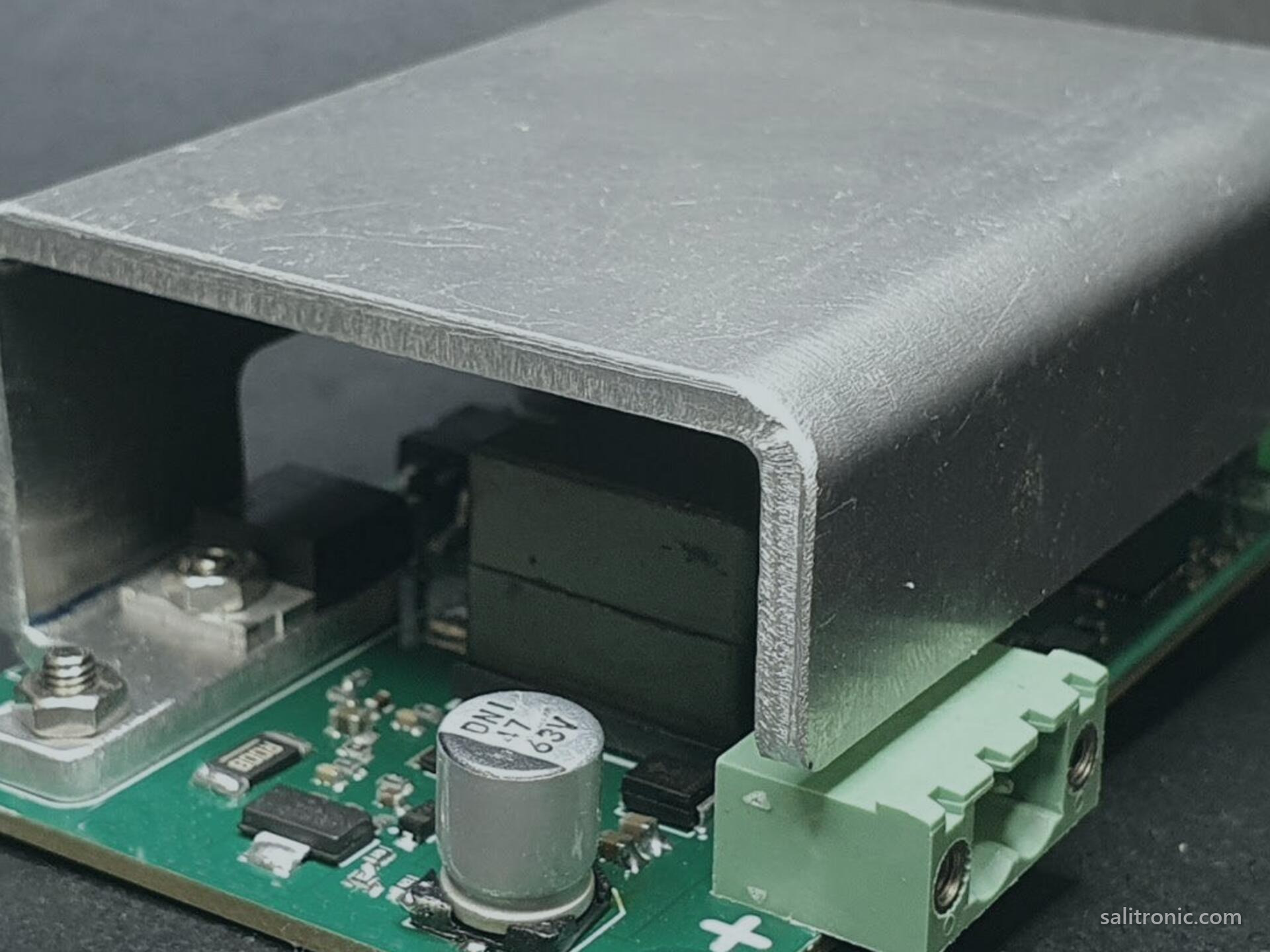
Modern power design balances efficiency, noise, size, cost, and thermal performance all at once. Switching supplies are efficient but generate noise; linear regulators are quiet but dissipate heat. The art is in selecting the right topology and implementing it correctly for each application, whether the load is sensitive analog that demands ultra-low noise, digital that needs fast transient response, or a high-power stage that has to manage significant heat. From DC-DC converter and power supply design through to battery management system (BMS) and wider power electronics design, the aim is a rail that stays clean and thermally safe under the worst-case load, not just on the bench.
A complete power distribution plan showing all rails, sequencing requirements, and current budgets.
A detailed schematic with component selection, compensation network, and protection features.
Calculated and measured efficiency across the full operating range.
Power dissipation calculations, thermal simulation, and a cooling strategy sized for worst case.
Input filtering, layout guidelines, and shielding recommendations for EMC compliance.
Overcurrent, overvoltage, undervoltage, and thermal protection implemented into the design.
Documented procedures for verifying power supply performance in production.
Oscillations or poor transient response from improper loop compensation.
Switching noise coupling into sensitive analog circuits.
Components operating beyond their thermal limits under worst-case conditions.
Conducted or radiated emissions exceeding regulatory limits.
Battery life or heat dissipation worse than expected.
Missing or inadequate protection against fault conditions.
I define input voltage range, output voltages and currents, efficiency targets, noise requirements, and environmental conditions, then identify the critical constraints driving the design.
I select the optimal converter topology (buck, boost, buck-boost, flyback, and so on) and weigh the trade-offs between synchronous and non-synchronous designs and integrated versus discrete solutions.
I choose the controller IC, MOSFETs, inductors, and capacitors for the performance you need, and verify every component rating under worst-case conditions.
I complete the circuit design including compensation network, protection circuits, and filtering, then simulate to verify stability, transient response, and efficiency.
I prototype and bench-test to validate efficiency, transient response, thermal performance, and EMC behaviour, iterating as needed to meet every requirement.

An electronics design engineer with 20+ years of professional experience across analog, digital, RF, and power designs, delivered to clients in 15+ countries. Your project is handled by the person who has shipped hardware like it, start to finish.
See the project portfolioDC/DC converters, LED drivers, low-noise and low-ripple supplies, battery and charging circuits, and higher-power stages with proper thermal management.
Topology and component choice set the efficiency, and layout sets how well the heat and switching noise are managed. I size copper, thermal paths and filtering for the real load and verify temperatures on the bench.
Yes. Quiet power is often the difference between a measurement that works and one that does not, so I design the supply around the noise budget of the load.
Yes. I build and bench-test the board, including load and thermal checks, so the power stage is proven before production.
Yes. Battery management system (BMS) design, DC-DC converter design, and general power electronics design are all covered, from cell protection and balancing through to the switching supply, its layout, and the thermal path, so the design holds up under real worst-case load rather than only at nominal.
From milliwatt battery systems to kilowatt industrial converters, professional power design ensures efficient, reliable operation.
Start the Conversation