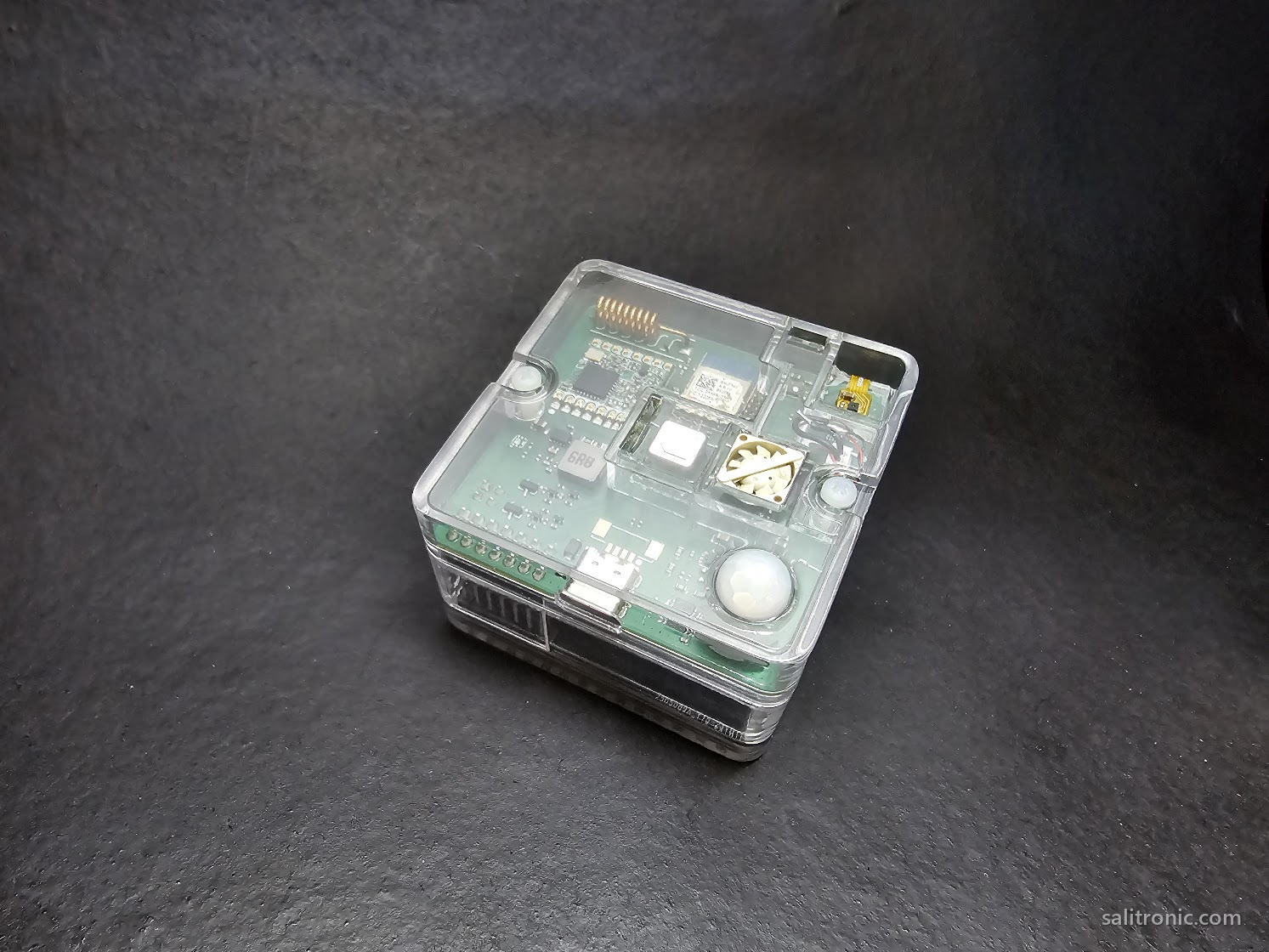
Single enclosure that monitors air quality (NOx, particulate matter), occupancy (PIR), temperature, humidity, and communicates over sub-GHz for building-wide coverage.
The Solution
Stacked PCB design: the sensor board sits above the radio/MCU board inside a vented enclosure. The PIR lens pokes through the housing, and the particulate matter sensor has its own airflow channel. A helical antenna provides compact, omnidirectional coverage for wall and ceiling mounting at any orientation. Gas sensor warm-up is staggered to avoid boot current spikes.
Results
Building managers get a combined occupancy + air quality view from one device per zone. The sub-GHz link reaches across entire floors through walls, the primary advantage over Wi-Fi or BLE.
How the stack is arranged
Two boards in one vented enclosure. The sensors sit on the upper board where the air and the PIR lens can reach them, the radio and MCU sit below, and the helical antenna covers every mounting orientation. Staggering the gas sensor warm-up keeps the boot current low.Why the gateway runs at 868 MHz. Every wall takes a bite out of the signal, and the bite gets larger as the frequency rises. Along a floor with a wall every 6 m, a 2.4 GHz link at BLE power runs out of margin after about 23 m, while the sub-GHz radio is still above its receiver limit at 71 m, which is what lets one device per zone report from anywhere on the floor.
Have a Similar Challenge?
Multi-sensor integration with long-range wireless is a regular design task.